
How to Run the First 90 Days in Demand Gen
Kelly Arndt
The plan you write on day one is not the plan you'll run. I'll save you a lot of stress by saying that up front.
I wrote a thorough 30-60-90 before I joined Vector as the first demand gen hire in seat. It didn't survive in its original form. Some of it didn't survive the first month, some got pushed, and some got dropped entirely. Then there were things I never planned for that ended up mattering more than anything on the list.
What was actually running on day one: zero evergreen campaigns, no attribution beyond the ad platforms, no MQL definition in the CRM, and a pile of ad accounts spun up for a couple of tests and gone quiet.
What my plan said I'd do: launch a newsletter by month two, own the ICP refresh end to end, define MQL in the CRM, build a UTM taxonomy, deliver a strategy document, get brand and conquest and thought leadership campaigns live.
What actually consumed my time: building signal architecture out of closed-won data, pulling daily campaign analysis into AI workflows, building AI workflows to scale ad content and landing pages, standing up surround-sound campaign infrastructure, and moving manual attribution into a real tool.
Demand gen at an early-stage company moves fast on every front, including the market, the product, the team, and the buyer. The plan is a useful starting point. The work is figuring out what to keep and what to throw out as you go.
The trap most new demand gen hires fall into
I'll probably get some hate for this, but most new demand gen hires over-index on perfect attribution and perfect dashboards before anything is actually live. The instinct is to defend work that hasn't happened yet. The cost is the first 60 days of momentum.
You need enough attribution to know what's working directionally. You do not need a fully built attribution platform with multi-touch and customer journey mapping before your first brand campaign goes live. Those are great things to have. They are not blockers.
Get directional reporting in place, ship campaigns fast, then build the sophisticated layers in parallel. If pipeline is growing, you don't need to defend a dashboard.
The trap looks like a perfect attribution stack before launch, five channels at once all under-resourced, a 30-page strategy doc with zero campaigns live, dashboards built to defend the work instead of decide what to do next, and trying to please every stakeholder in week one.
Your first Monday
Six things worth doing before you do anything else.
- Meet as many people on the team as you can. Sales, CS, product, ops, and especially marketing ops if that's a separate function. You'll need them more than you think.
- Watch sales calls, a lot of them. I watched 20 to 30 in my first month. You're listening for the language buyers use to describe the problem, not the language sales uses to pitch it.
- Watch CS kickoff calls too. This is where buyers restate, in their own words, why they bought. Best free positioning research you'll ever do.
- Audit how the market sees you. Pull Search Console and see what you index for, what competitors say about you, what customers say on LinkedIn. Where are you findable, and where are you not?
- Audit the CRM and ad accounts. Especially if you weren't the one who set them up. You don't have to fix it all in week one, but you should know what's broken.
- Run a creative inventory. What videos, copy, decks, and landing pages already exist that you could turn into a campaign this month? The answer is usually more than you think.
Days 1 to 30: listen, audit, ship
Get into the product. Use it. Demo it back to yourself. Find a way to be an actual customer of your own product in week one. I shipped two campaigns in my first week because I wanted to feel what our buyers feel. The sales calls I sat in after that made a lot more sense.
Listen for language, not just pain. The pain points matter, but the words buyers use to describe them matter more. I found a gap quickly between how sales was pitching the product and how customers actually talked about the problem they'd hired us to solve. That gap is worth looking for at any company you join, because it usually tells you something the messaging hasn't caught up to yet. One useful early test is a competitor conquest campaign, running against the established names in your category. You capture some of their traffic, and you learn how your product positions when it's sitting next to theirs.
Run a creative audit, then ship. Before you build anything new, find out what's already there. For me that meant reviewing content the team had built before I arrived, plus a candid conversation about what the budget could actually do. I had two campaigns live by the end of week one because the creative was already there and waiting. The goal wasn't to prove the strategy. It was to start learning from something live.
Pick one channel, maybe two. Pick wherever your ICP actually lives. For most B2B teams that's Google or LinkedIn or both. I went heavier on LinkedIn, roughly a 70/30 split, because we had momentum on LinkedIn organic and I knew our ICP was active there. Without a reason like that, I would have started with one and focused on getting the most out of it. The temptation when you're new is to hedge and launch everywhere, and it doesn't work. You learn less from five channels at half effort than from one channel you actually understand. You can always add. You can't get back the budget you spent proving that.
Days 31 to 60: let the platforms learn
This is the tricky stretch. Campaigns are live, you're watching numbers daily, nothing has compounded yet, and leadership is asking what's working.
Paid platforms need somewhere between two and four weeks to optimize before you can fairly judge a strategy. You can usually read creative performance within a week. You can read audience and targeting problems within two. Anything that requires the platform to actually learn, which is most things, needs longer.
Say this to leadership before they ask. I'm spending the first 30 days understanding the company, the market, and building the strategy. The second 30, I need to give the platforms time to learn. We'll judge what's working at the 60 to 90 day mark. Set that expectation up front and you get the runway. Skip it and you spend month two playing defense.
Within a new campaign, the read order is consistent. Week one, read the creative. If the ad isn't pulling clicks at all, the creative is wrong, and the signal is loud. If you're getting clicks but no conversions, look at the landing page. Week two, read the audience. Clicks but no relevant buyers arriving means targeting or audience definition is off, so tighten before you scale. Weeks three and four, read the strategy, because the platform has had time to optimize and what you're seeing is real.
By the end of month two, if the numbers are directionally working, the natural next layer is connecting campaigns into shared audience structures that feed each other. That's where compound interest builds. For us that became a surround-sound play: one core ICP audience, brand awareness on connected TV, retargeting back into LinkedIn engagement and thought leadership, plus a Google search layer to capture the demand the awareness campaigns created. You don't have to copy that structure. The principle worth stealing is layered campaigns on a shared audience, not five disconnected campaigns competing for the same budget.
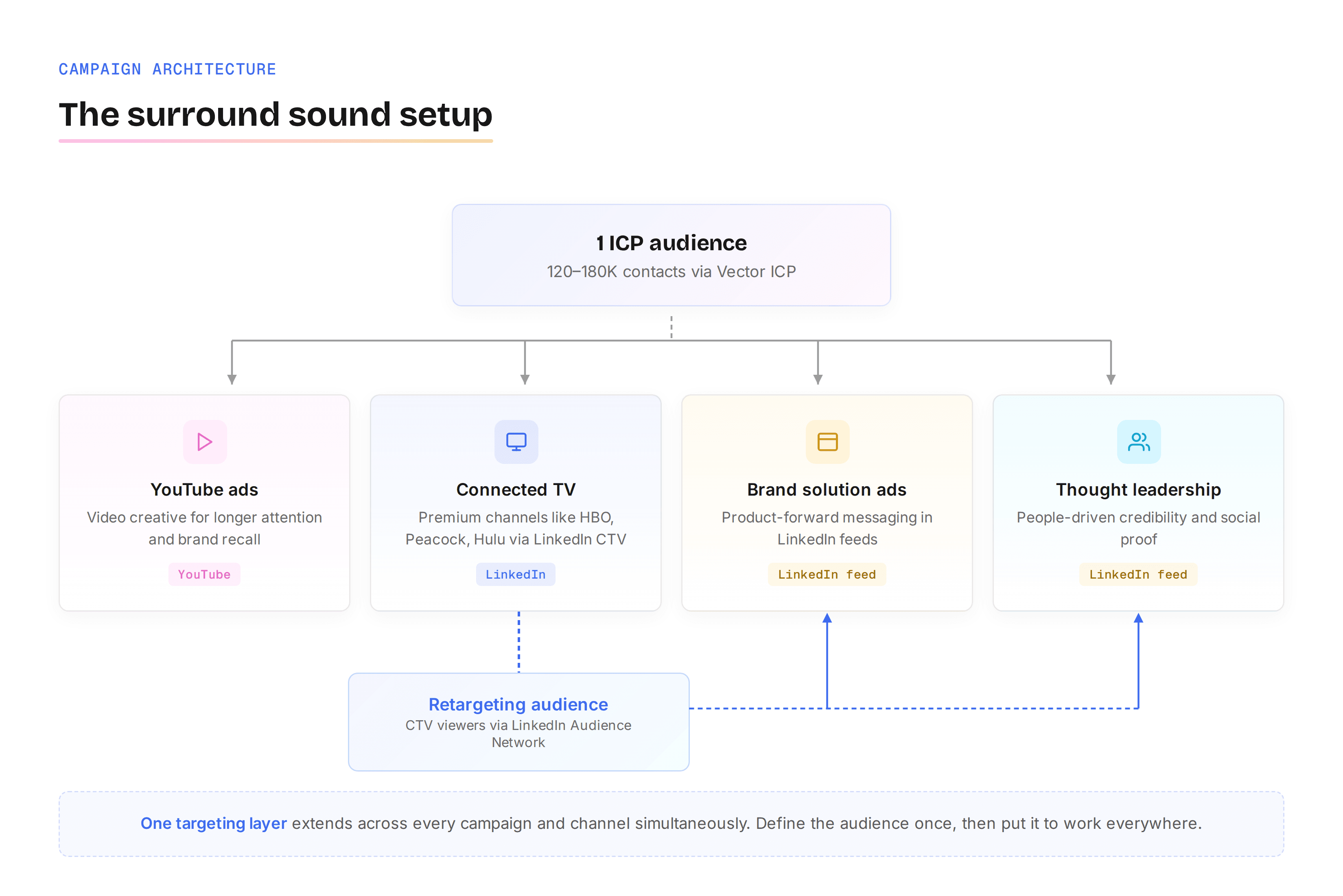

This is also when the signal conversation starts. You don't need a finished target account list or signal architecture yet. You do need to start asking which closed-won deals had which signals present before they closed, because that's the analysis that builds the list.
Days 61 to 90: optimize, refresh, retro
Month three is when you stop experimenting and start optimizing. The question shifts from whether anything is working to what to double down on.
Run an honest retro. The version that helps you is the one where you're willing to kill things that didn't work. The version that hurts you is the one designed to make the first 60 days look good. Worth asking: which campaigns produced pipeline, which produced engagement without pipeline, and which produced nothing. Which creative is fatiguing. Which channels punched above their weight and which underperformed and why. Which audiences engaged at higher rates and which you'd retire.
Then plan the next 90. By the end of month three you should have enough signal to say what the next quarter looks like, which for most teams at this stage means doubling down on what worked, starting the signal or ABM motion, and building a more mature reporting layer.
On reporting at 90 days, you should have enough to show direction, not enough to defend every dollar. Attribution work takes longer than that, and setting that expectation early is the same play as asking for platform learning time in month one.
Full disclosure on my own first 90. The newsletter never happened. The ICP refresh I'd planned to own end to end became a team project. A chunk of attribution work I'd planned to handle manually moved to a tool because the scope grew past what I should have been hand-building. That's a normal part of the job adapting around the work that actually mattered.
The stack decision framework
Most new demand gen hires inherit a half-built stack. Some of it is essential on day one, some can wait, and knowing the difference saves you from buying tools that don't change your pipeline.
Three layers. If something doesn't help you ship work in the next 90 days, it's probably not a day-one tool.
Day one foundation. A CRM. One or two ad platforms. An audience builder. Engagement visibility. Design resources, whether that's a freelancer or a tool that helps you ship creative fast. Conversion tracking plus basic last-touch attribution.
Month two, add as needed. A reporting tool for offline conversion tracking and customer journey mapping, once manual lift exceeds the cost of the tool.
Later, once you've earned it. A purpose-built multi-touch attribution platform. Creative automation. Dedicated outbound orchestration.
For transparency about what I actually used: Vector for the audience layer and for engagement visibility, since it let me define an audience at the contact level without needing a target account list first, and tell me by name who clicked ads and visited the site. I used in-platform reporting and CRM last-touch for the first 60 days, paired with Looker Studio and Supermetrics for manual reporting, then bought a reporting tool around month two when the manual work outgrew what I should be doing by hand.
Marketers tend to over-index on tools that help us defend our work and under-index on tools that help us ship it. If you're choosing between a reporting platform and a tool that gets your ads in front of the right buyers, ship first and report second.
The attribution question
This is where new demand gen hires lose the most time, so here's the version I'd want handed to me on day one.
What you genuinely need to launch is three things. Conversion tracking from website to ad platforms, meaning tag manager configured, conversion actions defined, UTM parameters and taxonomy defined. Offline conversion tracking from CRM to ad platforms, so the platforms know when a demo or trial became a qualified lead and when it closed, which is what stops them optimizing toward bots and non-ICP form-fillers. And last-touch plus first-touch reporting in the CRM, even if it's just UTMs tied to a lead source field, so you can tell a directional story by month two.
What you can wait on is everything else, including the parts that feel essential right now. Multi-touch attribution. Customer journey mapping. Impression-level account influence. A purpose-built platform. All valuable. None of them block your first campaign.
Signal architecture, and when to start
Most new demand gen hires think signal-based playbooks are a month-six or month-nine problem. I thought so too. The architecture starts in month two, even if activation happens later.
The framework I use has three dimensions. Fit and relevance happen at the company level. Engagement happens at the person level. The most valuable accounts and contacts sit at the intersection of all three.
Fit is who this company is, statically. Firmographics, industry, size, geography, vertical fit, tech stack when you can know it.
Relevance is what's happening at the company right now that makes them likelier to buy. A new role posting, a recent acquisition, a new market launch, a funding event, a leadership change.
Engagement is what a specific person is doing that indicates interest. Visited the site or pricing page, attended an event, engaged with your ads or content, recently changed roles into the buying seat.
Then the narrowing exercise, which is what actually produces something usable. Pull your last 10 to 20 closed-won deals. For each one, work backward through the signals present before they closed, across all three dimensions. Build a hypothesis list. I started with around 35. Then narrow to the five or six that showed up most consistently, and those become your foundation.
Going from 35 to five or six feels brutal. It is. But the discipline of narrowing is what makes the signal-based campaigns work later, because you're targeting patterns that actually predict wins instead of whatever's easiest to query. Complex signal architecture is earned over time.
I'd planned this work for the end of the year and it became one of the bigger pieces of my first 90 days. Once you start asking which closed-won deals had which signals, that question pulls on a lot of threads, including audience definition, the target account list, and how the team talks about who's worth pursuing. Signals also shape who your broader campaigns reach, so even for brand awareness the signal layer informs how you narrow from broad reach to the people most likely to be in market.
Using AI without drowning in it
My first 90 days landed at a moment when AI tooling got dramatically better, and I shifted a lot of my workflow into it. Looking back, I started in the wrong place.
Start in chat, with work you're already an expert at. The most useful version of AI for a demand gen leader is small and specific. Build a workflow for the thing you do every week, where you know what good looks like, and get the output to 90% of how you'd do it yourself. Then use it daily. Automating the entire stack can wait.
If you start in your own domain expertise, you have taste. You can tell when the output is wrong. AI is fast and confident, and if you don't have the expertise to push back, confident output starts to look like correct output. That's how you end up with polished, structured, very confident slop in your campaigns.
A rough priority order. Work you know, done weekly, is where to start: campaign analysis, paid pacing, creative briefs, ad copy variants, audience research. Work you know, done rarely, is a good fit with lower payoff, like quarterly reviews and board updates. Work you don't know, done weekly, is useful for learning and risky for shipping unless you have a reviewer. For me that was design and web development, and it was far harder to get a good result without the core expertise. Work you don't know, done rarely, is last. Vibe-coding an app in your first month on the job belongs here. I tried it. It was fun. I don't recommend it as a starting point.
One last thing
If you're reading this on day one of a new demand gen role, I'm rooting for you. The first 90 days are weird and fast and can be a little lonely. This is the closest thing I have to passing notes.